
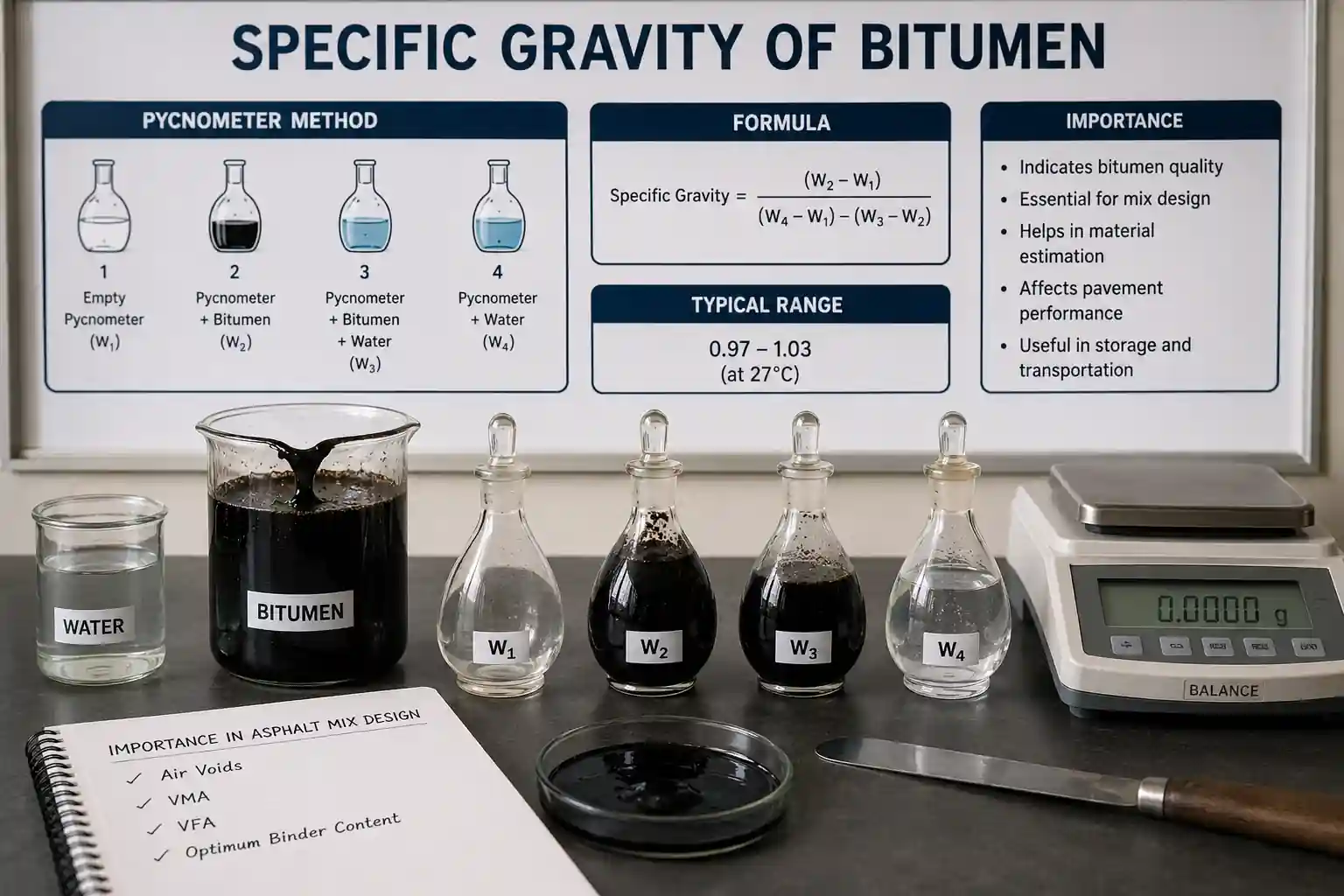
Bitumen plays a critical role in road construction, waterproofing systems, and industrial applications. However, before engineers and contractors use bitumen in any project, they must understand its physical properties. One of the most important properties is the specific gravity of bitumen.
Specific gravity helps engineers determine the quality, density, performance, and suitability of bitumen for different applications. Moreover, it influences mix design calculations, transportation costs, storage requirements, and pavement performance.
In this comprehensive guide, we will explain the specific gravity of bitumen, how to calculate it, why it matters, standard test methods, factors affecting it, and its role in asphalt pavement construction.
What Is Specific Gravity of Bitumen?
The specific gravity of bitumen is the ratio of the weight of a given volume of bitumen to the weight of an equal volume of water at a specified temperature.
In simple terms, specific gravity tells us how heavy bitumen is compared to water.
The formula is:
Specific Gravity = Weight of Bitumen / Weight of Equal Volume of Water
Since it is a ratio, specific gravity has no unit. For most paving-grade bitumen products, the specific gravity usually ranges between 0.97 and 1.03 at 27°C. However, the exact value depends on the source of crude oil, refining process, and bitumen grade.
Why Is Specific Gravity of Bitumen Important?
Specific gravity is not just a laboratory value. Instead, it affects many practical aspects of construction and engineering.
1. Helps Determine Bitumen Quality
Specific gravity provides useful information about the composition and consistency of bitumen. Therefore, engineers often use it as a quality control parameter.
When the measured value differs significantly from the expected range, it may indicate contamination or inconsistencies in production.
2. Essential for Asphalt Mix Design
Asphalt mix design requires accurate calculations of volume and weight relationships.
Since bitumen binds aggregates together, engineers must know its specific gravity to determine:
- Air voids
- Voids in mineral aggregate (VMA)
- Voids filled with asphalt (VFA)
- Optimum binder content
As a result, accurate specific gravity values improve pavement performance.
3. Supports Material Quantity Calculations
Contractors frequently purchase bitumen by weight while applying it by volume.
Therefore, they use specific gravity to convert:
- Weight to volume
- Volume to weight
This conversion ensures accurate material estimation and cost control.
4. Improves Pavement Performance
Specific gravity influences the volumetric properties of asphalt mixtures.
Consequently, proper determination helps engineers design durable pavements with better resistance to:
- Rutting
- Cracking
- Moisture damage
- Fatigue failure
5. Assists Storage and Transportation Planning
Because bitumen is transported in tanks and containers, engineers need density-related information.
Specific gravity helps determine:
- Tank capacity
- Loading limits
- Storage requirements
- Transportation efficiency
Difference Between Specific Gravity and Density of Bitumen
Many people confuse specific gravity with density. Although they are related, they are not the same.
| Property | Specific Gravity | Density |
|---|---|---|
| Definition | Ratio compared to water | Mass per unit volume |
| Unit | No unit | kg/m³ or g/cm³ |
| Purpose | Relative comparison | Actual measurement |
| Dependence | Relative value | Absolute value |
For example:
- Density of bitumen = 1010 kg/m³
- Density of water = 1000 kg/m³
Specific Gravity:
1010 ÷ 1000 = 1.01
Therefore, the specific gravity of the bitumen is 1.01.
Typical Specific Gravity Values of Bitumen
The specific gravity of bitumen varies according to its type and grade.
| Bitumen Type | Typical Specific Gravity |
|---|---|
| VG 10 | 0.99 – 1.01 |
| VG 20 | 0.99 – 1.02 |
| VG 30 | 1.00 – 1.03 |
| VG 40 | 1.01 – 1.03 |
| Oxidized Bitumen | 1.01 – 1.06 |
| Polymer Modified Bitumen | 1.00 – 1.05 |
| Emulsion Bitumen | 1.01 – 1.10 |
These values may vary depending on manufacturing processes and raw materials.
Factors Affecting Specific Gravity of Bitumen
Several factors influence the specific gravity of bitumen.
Source of Crude Oil
Different crude oil sources contain different chemical compositions.
As a result, bitumen produced from one refinery may have a slightly different specific gravity than bitumen produced elsewhere.
Refining Process
The refining process removes lighter fractions from crude oil.
Consequently, changes in refining conditions can affect the final specific gravity.
Temperature
Temperature significantly affects bitumen properties.
As temperature increases, bitumen expands and its density decreases.
Therefore, engineers always measure specific gravity at a standard temperature.
Oxidation
Over time, oxidation changes the chemical structure of bitumen.
Because oxidized bitumen becomes harder and denser, its specific gravity may increase slightly.
Additives and Modifiers
Manufacturers often add polymers, rubber, or other modifiers to improve performance.
These additives can change the specific gravity of the final product.
How to Measure Specific Gravity of Bitumen
Engineers use standardized laboratory methods to determine specific gravity.
The most common method uses a pycnometer.
Pycnometer Method
The pycnometer method provides accurate and reliable results.
Equipment Required
- Pycnometer bottle
- Analytical balance
- Distilled water
- Thermometer
- Heating device
Testing Specific gravity of Bitumen
Step 1: Weigh Empty Pycnometer
First, clean and dry the pycnometer.
Then weigh it accurately.
Record the weight as:
W1
Step 2: Fill with Bitumen
Next, heat the bitumen until it becomes fluid.
Pour it into the pycnometer and allow it to cool.
Weigh again.
Record as:
W2
Step 3: Add Water
Afterward, fill the remaining volume with distilled water.
Then weigh the pycnometer.
Record as:
W3
Step 4: Measure Water Weight
Empty the pycnometer completely.
Fill it only with distilled water.
Weigh again.
Record as:
W4
Calculation Formula
Specific Gravity =
(W2 − W1) ÷ [(W4 − W1) − (W3 − W2)]
The resulting value represents the specific gravity of bitumen.
Standard Specifications for Specific Gravity Testing
Several international standards describe testing procedures.
ASTM Standards
The most widely used standard is:
ASTM D70 – Standard Test Method for Density of Semi-Solid Bituminous Materials
This standard provides detailed instructions for laboratory testing.
AASHTO Standards
Transportation agencies often follow:
This method aligns closely with ASTM procedures.
IS Standards
In India, engineers commonly use:
IS 1202 – Determination of Specific Gravity and Density of Bitumen
This standard specifies equipment requirements, procedures, and calculations.
Relationship Between Specific Gravity and Asphalt Mix Design
Specific gravity plays a major role in asphalt pavement design.
Without accurate values, volumetric calculations become unreliable.
Aggregate-Bitumen Ratio
Engineers use specific gravity to determine the correct proportion of:
- Aggregates
- Bitumen
- Air voids
As a result, the pavement achieves optimum strength and durability.
Air Void Calculations
Air voids directly affect pavement performance.
Too many voids allow water infiltration.
Too few voids cause rutting and bleeding.
Therefore, specific gravity measurements help achieve the proper balance.
Marshall Mix Design
The Marshall method relies heavily on specific gravity calculations.
Engineers use these values to determine:
- Stability
- Flow
- Density
- Void characteristics
Consequently, accurate measurements improve mix performance.
Specific Gravity of Bitumen vs Specific Gravity of Aggregates
Both bitumen and aggregates have specific gravity values, but they differ significantly.
| Material | Typical Specific Gravity |
|---|---|
| Bitumen | 0.97 – 1.03 |
| Sand | 2.60 – 2.75 |
| Crushed Stone | 2.60 – 2.90 |
| Gravel | 2.50 – 2.80 |
Because aggregates are much heavier than bitumen, they make up most of the asphalt mixture weight.
However, bitumen occupies an important portion of the mixture volume.
Advantages of Determining Specific Gravity of Bitumen
Testing specific gravity provides several benefits.
Accurate Quality Control
Manufacturers can verify product consistency and compliance with standards.
Better Mix Design
Engineers can create more durable asphalt pavements.
Improved Cost Estimation
Contractors can accurately calculate material requirements.
Enhanced Performance Prediction
Specific gravity data helps predict pavement behavior under traffic and environmental conditions.
Easier Material Comparison
Engineers can compare different bitumen grades and sources more effectively.
Common Errors During Testing
Even a simple test can produce inaccurate results if technicians do not follow proper procedures.
Incorrect Temperature Control
Temperature changes affect volume and density.
Therefore, laboratories must maintain standard testing temperatures.
Air Bubbles
Trapped air can alter measurements.
As a result, technicians should remove all air bubbles before weighing.
Contaminated Equipment
Dirty equipment can affect results.
Therefore, pycnometers must remain clean and dry.
Inaccurate Weighing
Precision balances are essential for reliable calculations.
Regular calibration helps maintain accuracy.
Practical Applications of Specific Gravity of Bitumen
Specific gravity measurements support many real-world applications.
Highway Construction
Road engineers use specific gravity values to design durable asphalt pavements.
Airport Runways
Runway pavements require strict quality control.
Therefore, specific gravity testing becomes an important part of material evaluation.
Waterproofing Systems
Manufacturers use specific gravity data when producing waterproofing membranes and coatings.
Roofing Applications
Bitumen roofing products require consistent material properties.
Consequently, specific gravity testing helps maintain product quality.
Industrial Bitumen Products
Many industrial applications rely on accurate density and specific gravity values for manufacturing control.
Conclusion: Specific gravity of Bitumen
The specific gravity of bitumen is one of the most important physical properties used in road construction, waterproofing, roofing, and industrial applications. It represents the ratio between the weight of bitumen and the weight of an equal volume of water at a specified temperature.
Moreover, specific gravity plays a vital role in asphalt mix design, quality control, material estimation, transportation planning, and pavement performance evaluation. Engineers use standardized methods such as the pycnometer test to obtain accurate values and ensure compliance with industry specifications.
Because even small variations can affect pavement durability and volumetric calculations, accurate determination of specific gravity remains essential for every bitumen-related project. Therefore, understanding and testing this property helps engineers, contractors, and manufacturers achieve better performance, longer service life, and improved construction quality.
Frequently Asked Questions (FAQ) Specific gravity of Bitumen
What is the specific gravity of bitumen?
The specific gravity of bitumen is the ratio of the weight of a given volume of bitumen to the weight of an equal volume of water at a specified temperature.
What is the typical specific gravity range of bitumen?
Most paving-grade bitumen products have a specific gravity ranging from 0.97 to 1.03.
Why is specific gravity important in asphalt mix design?
Specific gravity helps engineers calculate air voids, aggregate proportions, asphalt content, and other volumetric properties required for durable pavement design.
How is the specific gravity of bitumen measured?
Engineers commonly measure it using the pycnometer method according to ASTM, AASHTO, or IS standards.
Does temperature affect the specific gravity of bitumen?
Yes. As temperature increases, bitumen expands and its density decreases, which affects specific gravity measurements.
What is the difference between density and specific gravity?
Density measures mass per unit volume and has units, while specific gravity is a unitless ratio comparing a material’s density to water.
Can specific gravity indicate bitumen quality?
Yes. Significant variations from expected values may indicate contamination, improper processing, or quality inconsistencies.
What standard is used for testing the specific gravity of bitumen?
Common standards include ASTM D70, AASHTO T228, and IS 1202.
Is bitumen heavier than water?
Some bitumen grades are slightly heavier than water, while others are slightly lighter. Most have a specific gravity close to 1.0.
How does specific gravity affect pavement performance?
Accurate specific gravity values help engineers design asphalt mixtures with proper air voids, density, and durability, leading to longer-lasting pavements.