
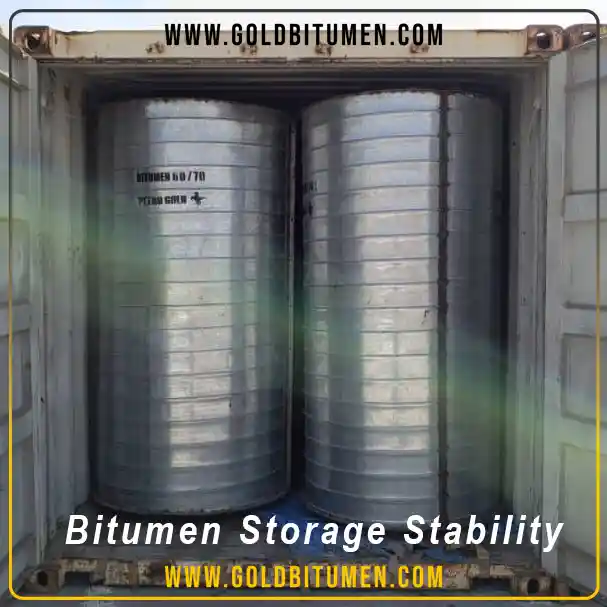
Goldbitumen, a trusted manufacturer of high-quality bitumen from Iran, works hard to ensure excellent bitumen storage stability from production to delivery. Because bitumen can change quickly when exposed to heat, air, or moisture, proper storage is extremely important. In fact, when storage conditions are poor, the binder loses flexibility, becomes harder, and performs much worse. Therefore, understanding how to protect bitumen during storage helps engineers, contractors, and buyers achieve better and longer-lasting results.
What Is Bitumen Storage Stability?
Bitumen storage stability refers to the ability of bitumen to stay uniform and unchanged while stored in drums, containers, or large tanks. Since bitumen is made of different hydrocarbons, heat, oxygen, and contaminants can easily affect its structure. However, when storage stability is good, the material keeps its:
color
elasticity
purity
Consequently, stable bitumen performs exactly as expected during mixing and application.
Why Bitumen Storage Stability Matters
Bitumen that is stored incorrectly loses quality much faster. For example, it may harden, separate, or absorb moisture. As a result, the final asphalt becomes weaker. Additionally, poor storage often leads to sediment, air bubbles, and large fluctuations in viscosity. Because these issues directly reduce road life, bitumen storage stability must always be protected.
Main Factors Affecting Bitumen Storage Stability
Several important factors influence stability, and each one requires attention.
1. Temperature Fluctuation
Temperature change is the biggest threat. If bitumen is heated too high, it oxidizes quickly. If it cools too much, it becomes thick and unstable. Therefore, maintaining a constant temperature is essential for stability.
2. Air Exposure
Whenever bitumen contacts oxygen, oxidation begins immediately. As a result, the bitumen becomes harder and more brittle. For this reason, storage tanks and drums must be tightly sealed.
3. Moisture and Water Contamination
Water damages bitumen very quickly. Even a small amount of moisture creates bubbles and reduces bonding strength. Consequently, all drums and containers must remain completely dry.
4. Impurities from Tanks or Drums
If storage tanks contain rust or dust, these contaminants mix into the bitumen. As a result, the penetration and viscosity values change. Therefore, all tanks must be clean before filling.
5. Additives and Polymer Separation
Polymer-modified bitumen (PMB) can separate during storage. However, with proper mixing and temperature control, stability remains strong.
How to Maintain Excellent Bitumen Storage Stability
Fortunately, there are many safe and effective methods to protect bitumen.
Store Bitumen at Correct Temperatures
Keeping the bitumen within the recommended temperature range greatly improves stability. For example:
Penetration grades: 140–160°C
Viscosity grades: 150–170°C
Oxidized bitumen: 180–200°C
When these temperatures are respected, bitumen remains stable for much longer.
Use Clean, Insulated Storage Tanks
Insulated tanks reduce heat loss and prevent rapid cooling. Meanwhile, clean tanks prevent contamination. Because both temperature and purity matter, these steps significantly improve bitumen storage stability.
Avoid Air Exposure
Using nitrogen blanketing or sealed tank lids reduces oxidation. As a result, penetration and viscosity stay stable over time.
Avoid Long-Term Overheating
If bitumen stays hot for too many days, it becomes harder. Therefore, only heat the bitumen when necessary.
Mix or Circulate When Needed
Some materials, especially PMB, require constant or periodic mixing. This prevents polymer separation and ensures uniform performance.
Store Drums Carefully
Drums should stay upright, dry, and away from sunlight. Because sunlight causes oxidation, shade helps protect storage stability.
How to Test Bitumen Storage Stability
Laboratory tests are essential, and they reveal how well the binder maintains quality.
• Softening Point Difference
A small difference between top and bottom samples means high stability.
• Penetration Change
If penetration remains nearly the same after storage, stability is strong.
• Viscosity Test
Stable viscosity proves the bitumen has not separated or aged.
• Visual Inspection
Experts check for sediment, separation, color change, and surface skin. Generally, clean and uniform appearance indicates good bitumen storage stability.
Special Notes on PMB Storage Stability
Polymer-modified bitumen behaves differently. Although PMB is stronger, it can separate during storage. Because of this, steady temperature, proper agitation, and correct additives are necessary.
How Goldbitumen Ensures Strong Storage Stability
Goldbitumen maintains strict quality control by:
using clean and insulated tanks
sealing drums tightly
avoiding rapid temperature changes
using high-quality additives
performing ASTM stability tests
preventing moisture
As a result, customers receive stable bitumen that performs reliably in all applications.
Conclusion: Bitumen Storage Stability Protects Long-Term Performance
In summary, bitumen storage stability is essential for preserving penetration, viscosity, and elasticity. Because poor storage causes rapid aging, the binder must be protected from heat, air, and contamination. Fortunately, with proper storage methods, bitumen stays stable and strong. That is why choosing a reliable supplier like Goldbitumen ensures high-quality bitumen that maintains its stability from production to final application.