
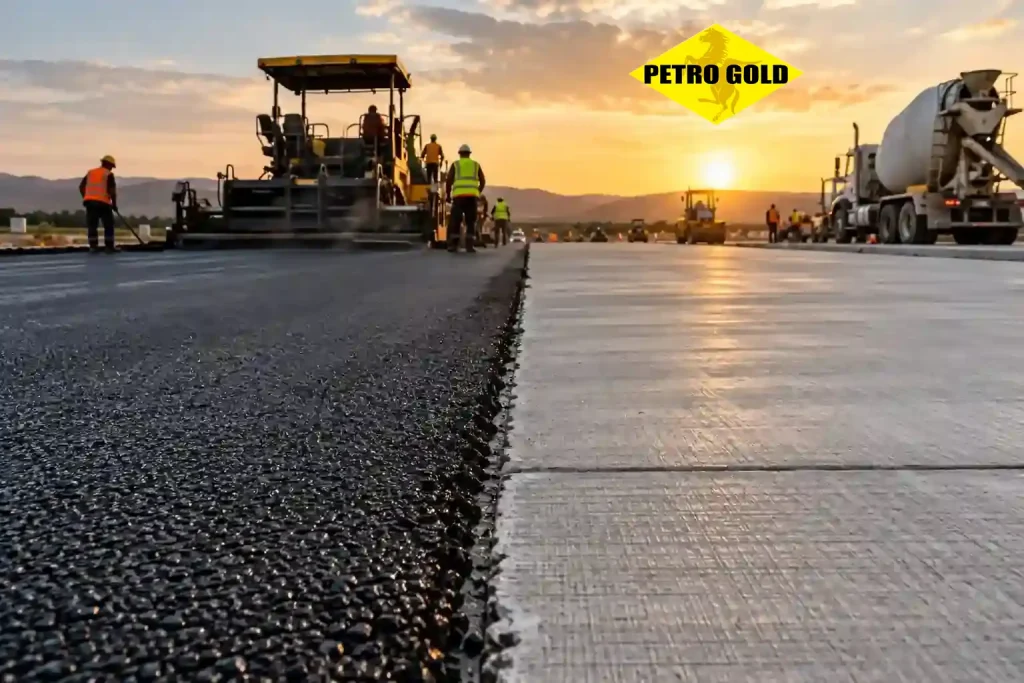
Asphalt vs concrete—which material offers better value for road construction? Asphalt usually provides faster installation, easier repairs, and lower initial construction costs. Concrete offers high structural strength and can deliver longer service intervals under heavy traffic. However, neither material wins in every situation. Climate, traffic loads, maintenance budgets, and pavement design determine the best choice. For highways, industrial roads, parking areas, and residential driveways, contractors must compare more than the initial price. This guide explains the real differences between asphalt and concrete, including durability, lifecycle costs, environmental performance, and several overlooked factors that influence long-term pavement quality.
What Is the Difference Between Asphalt and Concrete?
Asphalt and concrete serve the same basic purpose: they create durable surfaces that support vehicles, pedestrians, and industrial equipment.
However, they use different binding materials and respond differently to traffic and temperature changes.
Asphalt pavement combines mineral aggregates, such as crushed stone and sand, with bitumen. The bitumen binds the aggregates together and gives the pavement its flexible, viscoelastic behavior.
Concrete pavement combines cement, aggregates, water, and sometimes chemical or mineral additives. Cement reacts with water and creates a rigid structure that distributes loads through slab action.
This difference affects nearly every stage of pavement construction, from material selection to maintenance planning.
Asphalt vs Concrete: Quick Comparison
| Feature | Asphalt Pavement | Concrete Pavement |
|---|---|---|
| Main binder | Petroleum bitumen | Hydraulic cement |
| Pavement structure | Flexible | Rigid |
| Initial cost | Often lower | Often higher |
| Construction speed | Usually faster to reopen | Depends on curing and mix design |
| Maintenance | Periodic sealing, patching, resurfacing | Joint maintenance, repairs, grinding |
| Heavy traffic | Performs well with proper design | Offers strong load distribution |
| Hot weather | May develop rutting | Resists rutting but can develop joint or slab distress |
| Cold weather | Can develop thermal cracks | Can develop cracking and joint movement |
| Recycling | Supports reclaimed asphalt pavement | Supports crushed concrete reuse |
| Surface appearance | Usually dark | Usually light gray |
| Noise | Can provide quiet surfaces with suitable mixes | Depends on surface texture |
| Design life | Project-specific | Project-specific |
Both pavement types can deliver excellent results. Engineers must match the pavement structure to local conditions rather than choose a material based on general assumptions.
Asphalt vs Concrete Cost: Which Is More Affordable?
Construction cost often drives the initial decision between asphalt and concrete.
Asphalt generally offers a lower upfront cost for many conventional paving projects. Contractors can place and compact asphalt quickly, while paving crews can often reopen the surface after the mixture cools sufficiently.
Concrete projects frequently require higher initial spending on materials, formwork, joint construction, and curing arrangements.
However, actual costs depend on local material prices, pavement thickness, labor rates, equipment availability, and structural requirements.
Initial Construction Costs
Several factors determine the final paving budget:
Aggregate and binder prices
Required pavement thickness
Subgrade strength and preparation
Transportation distance
Labor and equipment expenses
Drainage infrastructure
Traffic management requirements
For example, an asphalt plant located near the construction site may reduce transportation expenses significantly.
Conversely, a project with convenient access to cement and concrete production facilities may find concrete more competitive.
Contractors should request comparable structural designs before comparing quotations. A thin asphalt surface and a heavy-duty concrete slab do not provide equivalent performance simply because both cover the same area.
Long-Term Maintenance Costs
Asphalt often requires periodic crack sealing, surface treatments, or overlays.
Concrete may require fewer major surface interventions under certain conditions, but joint repairs, slab replacement, and surface restoration can create substantial expenses.
The most economical solution depends on the complete maintenance schedule.
A pavement that costs less initially may require more rehabilitation work. A more expensive pavement may justify its price through longer intervals between major repairs.
Important: Compare the total cost of ownership, not just the cost per square meter.
Asphalt vs Concrete Lifespan: Which Lasts Longer?
Many contractors describe asphalt as a 15–20-year pavement and concrete as a 30–40-year pavement.
These figures can serve as rough planning examples, but they do not represent universal service-life guarantees.
Engineers can design asphalt and concrete pavements for different service periods. Traffic loads, construction quality, drainage, and maintenance strongly influence actual performance.
Factors That Affect Asphalt Lifespan
Asphalt performance depends on several connected variables.
Bitumen quality: The binder must resist excessive deformation at high temperatures and cracking at low temperatures.
Aggregate structure: Properly graded and durable aggregates create a stable pavement skeleton.
Compaction: Adequate density limits excessive air voids and reduces water penetration.
Drainage: Effective drainage protects the base and subgrade against moisture damage.
Traffic loading: Heavy vehicles place greater stress on pavement layers than passenger cars.
Modern asphalt designs can extend pavement life through improved mixtures, stronger foundations, and preventive maintenance.
Factors That Affect Concrete Lifespan
Concrete performance depends on slab thickness, concrete strength, joint design, curing, and foundation support.
Poor joint construction can create cracking and faulting even when the concrete achieves its specified compressive strength.
Likewise, inadequate drainage can weaken support beneath concrete slabs and accelerate deterioration.
Concrete can offer long structural service, but contractors must still inspect and maintain joints, surfaces, and drainage systems.
Which Performs Better Under Heavy Traffic?
Heavy traffic creates one of the most important differences between asphalt and concrete.
Concrete distributes wheel loads through relatively stiff slabs. This characteristic can make concrete attractive for ports, industrial yards, bus stops, and areas where heavy vehicles frequently stop or turn.
Asphalt distributes loads through several pavement layers. Engineers can increase its thickness and improve its mixture design to accommodate heavy commercial traffic.
Asphalt Performance Under Heavy Loads
Conventional asphalt may develop permanent deformation when high pavement temperatures combine with repeated heavy loading.
Engineers call this deformation rutting.
They can reduce rutting risk through:
Appropriate performance-graded binders
Polymer-modified bitumen
Strong aggregate interlock
Correct mixture design
Adequate compaction
Sufficient structural thickness
For demanding road projects, modified binders can improve resistance to permanent deformation while maintaining useful flexibility.
Concrete Performance Under Heavy Loads
Concrete offers strong resistance to rutting because its rigid structure limits permanent wheel-path deformation.
However, repeated loading can produce fatigue cracking, joint deterioration, and slab movement.
Concrete also requires suitable load-transfer systems and foundation support.
Neither pavement type can compensate for a poorly designed foundation.
Asphalt vs Concrete in Hot and Cold Climates
Temperature affects pavement performance throughout its service life.
Both materials expand and contract as environmental conditions change, but their different structures produce different types of distress.
Hot Climate Performance
High temperatures soften asphalt binders and can increase the risk of rutting.
This challenge becomes especially important in regions with intense summer heat and heavy truck traffic.
Engineers can improve hot-weather asphalt performance by selecting suitable binder grades and stable aggregate structures.
For example, performance-graded binders such as PG 64-22 or PG 76-22 may suit certain pavement designs, depending on local pavement temperature calculations and traffic conditions.
The grade numbers represent binder performance-temperature classifications, not simple air-temperature limits.
Concrete generally offers strong resistance to rutting in hot climates. However, high temperatures can increase slab expansion, curling stresses, and joint-related problems.
Cold Climate Performance
Low temperatures make asphalt binders stiffer.
If the pavement contracts beyond the binder’s ability to accommodate movement, thermal cracking may occur.
Suitable low-temperature binder grades can reduce this risk.
Concrete also experiences temperature-related contraction and expansion.
Engineers use joints, reinforcement where appropriate, and careful curing practices to manage cracking.
The key consideration is climate compatibility, not simply choosing the harder material.
Asphalt vs Concrete for Highways and Road Construction
Highway projects require a balance between construction speed, traffic capacity, durability, and maintenance access.
Asphalt offers practical advantages when road authorities need to complete work during short closures.
Construction teams can place asphalt in stages, repair damaged sections, and restore traffic without replacing the entire pavement structure.
Concrete can perform well on highways with sustained heavy traffic, particularly where engineers prioritize long structural service and limited major rehabilitation.
However, conventional concrete needs sufficient strength before traffic can return.
Fast-track concrete mixtures and precast systems can shorten this period.
When Asphalt Makes More Sense
Asphalt may offer better project value when:
Contractors face tight construction schedules.
Road authorities need rapid resurfacing.
The project requires staged construction.
The existing pavement supports asphalt overlays.
Local asphalt production reduces transportation costs.
When Concrete Makes More Sense
Concrete may offer advantages when:
Heavy vehicles apply concentrated or slow-moving loads.
The project allows sufficient curing or uses fast-track methods.
Engineers require high structural stiffness.
Local concrete materials offer competitive prices.
The owner can support the required joint-maintenance program.
Asphalt vs Concrete for Driveways and Parking Areas
Residential driveways and commercial parking facilities have different operating requirements.
For residential driveways, asphalt often provides an economical and relatively fast paving solution.
Its dark surface creates a uniform appearance, and contractors can repair localized damage without replacing the entire driveway.
Concrete offers a lighter appearance and allows decorative finishes, patterns, and surface textures.
However, concrete driveway repairs can create visible color differences between old and new sections.
Commercial Parking Areas
Parking facilities introduce additional challenges.
Vehicles repeatedly brake, accelerate, and turn in confined spaces.
These movements can place significant shear stresses on asphalt surfaces, particularly near entrances, loading docks, and truck parking areas.
A properly designed asphalt mixture can handle these stresses.
Concrete may offer an advantage in locations where heavy trucks remain stationary for long periods.
Some facilities combine asphalt driving lanes with concrete loading zones to balance performance and cost.
Environmental Impact: Is Asphalt or Concrete More Sustainable?
Sustainability has become an important consideration in pavement design and infrastructure procurement.
However, comparing environmental performance requires more than examining the production emissions of one material.
Engineers should evaluate the complete pavement lifecycle.
Asphalt Recycling
Asphalt offers significant recycling opportunities.
Contractors can mill existing pavement and reuse reclaimed asphalt pavement (RAP) in new mixtures.
RAP contains valuable aggregates and aged bitumen.
With suitable mixture design and quality control, recycled material can reduce demand for virgin resources.
Warm-mix asphalt technologies can also reduce production temperatures and potentially lower energy consumption.
Actual savings depend on the technology, fuel source, production process, and construction conditions.
Concrete Recycling
Contractors can crush demolished concrete and reuse it as aggregate in selected construction applications.
Concrete producers can also reduce cement-related emissions through suitable supplementary cementitious materials and optimized mixture designs.
However, cement production remains an important source of emissions because it requires substantial energy and releases carbon dioxide during limestone calcination.
Which Has the Lower Carbon Footprint?
No single material always delivers the lowest environmental impact.
The result depends on:
Material production emissions
Pavement thickness
Transportation distances
Construction energy
Maintenance frequency
Recycling rates
Expected service life
End-of-life processing
A reliable comparison should use equivalent pavement performance and a clearly defined lifecycle assessment.
Five Overlooked Factors That Can Change the Best Pavement Choice
Many comparison articles focus only on price, strength, and lifespan.
However, several less obvious factors can change the final decision.
1. Traffic Closure Costs
A road closure creates costs beyond construction expenses.
Traffic delays can increase fuel consumption, disrupt deliveries, and reduce access to commercial properties.
For busy highways, these indirect expenses can influence the economic comparison significantly.
A faster paving method may justify a higher material price if it reduces disruption.
2. Pavement Temperature Versus Air Temperature
Engineers should not select asphalt binders using air temperature alone.
Dark asphalt surfaces can reach temperatures substantially above the surrounding air during sunny conditions.
Binder selection should account for expected pavement temperatures, traffic loading, and applicable specifications.
This distinction matters particularly in hot climates.
3. Vehicle Turning and Braking Zones
Road sections with slow-moving trucks may experience greater surface stresses than straight sections carrying faster traffic.
Truck terminals, intersections, and loading zones deserve special attention.
Engineers can improve asphalt mixture stability or specify concrete in selected high-stress areas.
4. Drainage Can Matter More Than Surface Material
Poor drainage can shorten the service life of either pavement type.
Water weakens unbound pavement layers and can accelerate several forms of deterioration.
A well-designed drainage system often delivers more long-term value than an unnecessary increase in surface thickness.
5. Maintenance Timing Changes Total Cost
Preventive maintenance generally costs less than major reconstruction when contractors apply it at the appropriate stage.
For asphalt, early crack sealing and surface preservation can delay more expensive rehabilitation.
For concrete, timely joint maintenance and localized repairs can help prevent larger structural problems.
Owners should plan maintenance before the pavement shows severe deterioration.
How Bitumen Quality Influences Asphalt Performance
The comparison between asphalt and concrete also highlights the importance of binder quality.
Concrete relies on cement-based bonding, while asphalt depends on bitumen to hold aggregates together and provide the mixture with appropriate viscoelastic properties.
Different pavement applications require different binder characteristics.
Penetration Grade Bitumen
Penetration grades such as Bitumen 60/70 and 80/100 classify bitumen according to needle penetration under standardized test conditions.
Contractors use these binders in various asphalt applications, depending on local specifications and climate.
However, penetration alone does not fully describe high-temperature rutting resistance or low-temperature cracking performance.
Performance Grade Bitumen
Performance-graded binders use a temperature-based classification system.
Engineers select suitable grades according to expected pavement temperatures and traffic conditions.
This approach helps connect binder properties with pavement performance requirements.
Polymer Modified Bitumen
Polymer modification can improve selected binder properties, including elasticity and resistance to permanent deformation.
Engineers often consider modified binders for demanding highways, heavily loaded intersections, and regions with challenging temperature conditions.
However, the correct polymer system, dosage, and mixture design determine the final result.
For international road projects, GoldBitumen supplies bitumen products for applications that require defined technical specifications and dependable export arrangements.
Buyers should request the relevant Technical Data Sheet, test results, and applicable standards before confirming an order.
How to Compare Asphalt and Concrete Using Lifecycle Cost
A lifecycle cost analysis helps project owners compare pavement alternatives over a common evaluation period.
Rather than focus only on initial construction, the analysis includes future maintenance, rehabilitation, and other relevant costs.
A simplified approach uses the following relationship:
Total Lifecycle Cost = Initial Construction Cost + Present Value of Future Maintenance and Rehabilitation Costs − Present Value of Residual Value
Project owners may also include traffic disruption costs when those costs influence the decision.
Illustrative 30-Year Cost Comparison
The following example uses hypothetical costs for two pavement alternatives serving the same road. It demonstrates the calculation method rather than predicting actual market prices.
| Cost Component | Asphalt | Concrete |
|---|---|---|
| Initial construction | $100,000 | $140,000 |
| Routine maintenance, undiscounted | $12,000 | $8,000 |
| Major rehabilitation, undiscounted | $35,000 | $15,000 |
| Total undiscounted expenditure | $147,000 | $163,000 |
In this simplified example, asphalt has a lower total undiscounted cost.
However, a complete lifecycle analysis must account for when each expense occurs, apply an appropriate discount rate, and consider residual pavement value.
A different maintenance schedule or traffic pattern could reverse the result.
The lesson: The cheapest construction quote does not always identify the most economical pavement.
Choosing the Right Pavement for Different Applications
| Application | Practical Starting Point | Main Consideration |
|---|---|---|
| Residential driveways | Asphalt or concrete | Budget, appearance, maintenance |
| Urban roads | Asphalt | Construction speed and repair access |
| Heavy truck terminals | Concrete or engineered asphalt | Stationary loads and turning stress |
| Highways | Either | Traffic, climate, lifecycle economics |
| Industrial yards | Concrete or heavy-duty asphalt | Load intensity and foundation strength |
| Parking lots | Asphalt | Initial cost and resurfacing flexibility |
| Bus stops | Concrete or rut-resistant asphalt | Repeated concentrated loading |
| Airport pavements | Either, depending on location | Aircraft loads and operational requirements |
These recommendations provide starting points rather than universal design rules.
A qualified pavement engineer should confirm the final structure using traffic forecasts, geotechnical data, drainage conditions, and applicable standards.
Frequently Asked Questions About Asphalt vs Concrete
Is asphalt better than concrete for roads?
Asphalt often offers faster construction, easier resurfacing, and competitive initial costs. Concrete provides high structural stiffness and can perform well under heavy traffic. The better choice depends on project conditions.
Which lasts longer, asphalt or concrete?
Concrete often provides longer intervals between major structural rehabilitation in conventional designs. However, engineers can design long-life asphalt pavements, and maintenance practices strongly affect both materials.
Is asphalt cheaper than concrete?
Asphalt frequently costs less initially, but local material prices and structural requirements influence the difference. A lifecycle cost analysis provides a more reliable financial comparison.
Which pavement performs better in hot weather?
Concrete resists rutting well, while asphalt requires appropriate binder selection and mixture design to control permanent deformation. Both materials need suitable thermal design.
Is concrete more environmentally friendly than asphalt?
Neither material always has a lower environmental impact. Recycling, material production, transportation, maintenance, and service life determine the lifecycle result.
Can contractors install asphalt over concrete?
Yes. Contractors can place asphalt overlays over existing concrete when the underlying pavement provides adequate support. They must assess joints, cracks, drainage, and reflective-cracking risks before construction.
Which material works better for heavy trucks?
Both materials can support heavy trucks when engineers design the pavement correctly. Concrete can offer advantages under stationary and slow-moving concentrated loads, while properly engineered asphalt can handle demanding highway traffic.
Does asphalt require more maintenance than concrete?
Asphalt commonly needs more frequent surface treatments or overlays in many conventional designs. Concrete may require less frequent major work, but joint maintenance and slab repairs remain important.
Conclusion: Asphalt vs Concrete — Which Should You Choose?
The asphalt vs concrete decision depends on more than material strength or installation cost.
Asphalt offers flexibility, rapid construction, practical repairs, and strong recycling opportunities. Concrete provides structural stiffness, resistance to rutting, and potentially long intervals between major rehabilitation.
For highway construction, industrial infrastructure, and commercial paving, engineers should evaluate traffic loads, climate conditions, foundation strength, construction schedules, and lifecycle costs.
Most importantly, buyers should prioritize material quality and technical compliance.
A well-designed asphalt pavement with the correct bitumen grade can deliver reliable long-term performance. Likewise, a properly engineered concrete pavement can support demanding applications for decades.
Choose the pavement that meets your project’s performance requirements at the lowest practical lifecycle cost—not simply the material with the lowest initial price.