
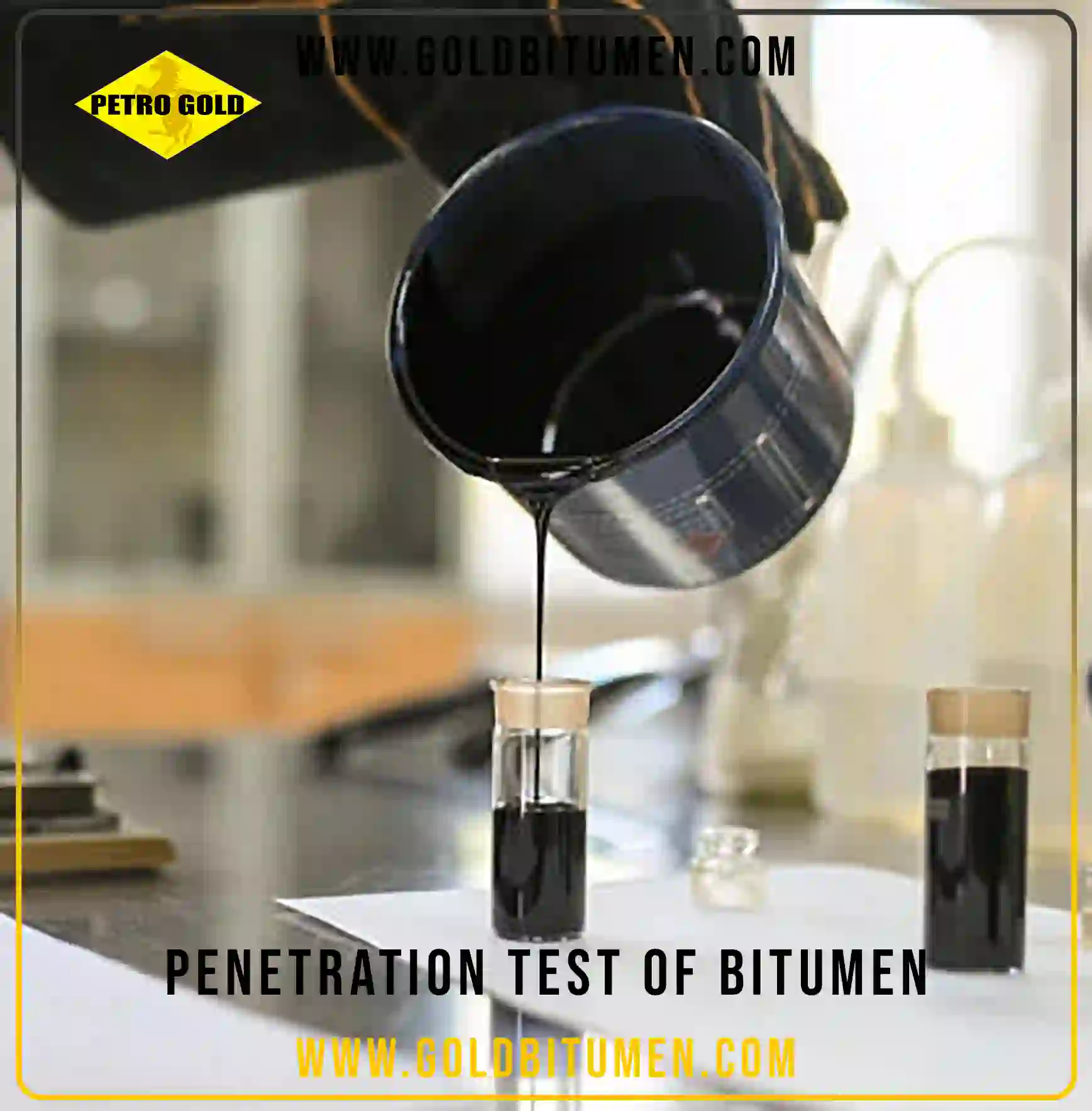
The penetration test of bitumen measures how hard or soft a bitumen grade is, and this simple test tells you how that bitumen will behave under real traffic and climate conditions. The test works by checking how far a standard needle can sink into a bitumen sample under specific temperature, load, and time. Because this measurement directly shows the consistency and performance level of bitumen, engineers use it to select the right grade for roads, waterproofing, asphalt layers, and industrial applications. In short, the penetration value is the first and most important indicator of how strong, durable, and reliable a bitumen binder will be in the field. Petro Gold, a trusted Iranian bitumen manufacturer, produces penetration-grade bitumen that follows global ASTM and EN standards to ensure accuracy and consistency.
What Is the Penetration Test of Bitumen? (Simple Explanation)
The penetration test of bitumen is a standard laboratory experiment that evaluates how easily a bitumen sample can be penetrated by a needle when pressure is applied.
In simple words:
The softer the bitumen → the deeper the needle goes → the higher the penetration number.
The harder the bitumen → the less the needle enters → the lower the penetration number.
This test helps classify bitumen into grades such as:
-
Bitumen 80/100
-
Bitumen 40/50
-
Bitumen 100/120
Each grade performs differently under heat, pressure, and load. Therefore, choosing the correct penetration grade ensures road durability and safety.
Why Is Penetration Test Important?
Engineers rely heavily on this test because it quickly reveals the bitumen’s suitability for different weather conditions and traffic loads.
For example:
-
Hot climates need harder bitumen (like 40/50 or 60/70) so roads don’t melt or rut.
-
Cold climates need softer bitumen (like 80/100 or 100/120) so the asphalt doesn’t crack.
Because the penetration test gives clear and repeatable values, it has become the world’s most widely used method for classifying paving bitumen.
How the Penetration Test Works (Step-by-Step)
Even though the test looks basic, each step must follow strict rules to produce trustworthy results. Here is a simple breakdown:
1. Prepare the Bitumen Sample
A small cup is filled with melted bitumen and left to cool until the surface becomes smooth.
2. Set Up the Penetrometer
A needle of standard size is attached to a device called a penetrometer, which measures the depth of penetration in 0.1 mm units, known as penetration units or “dmm”.
3. Adjust Test Conditions
The test always follows fixed conditions:
-
Temperature: 25°C
-
Load: 100 grams
-
Time: 5 seconds
These conditions ensure that results are the same across different laboratories and countries.
4. Run the Test
The needle is gently placed on the bitumen surface and allowed to penetrate under its weight for exactly five seconds.
5. Read the Value
The device then shows the penetration depth.
Example:
-
65 dmm → Bitumen 60/70
-
95 dmm → Bitumen 80/100
This value becomes the grade name for that bitumen.
Understanding Penetration Values
Let’s break down how penetration values affect real-world performance:
Higher Penetration (Soft Bitumen)
-
Needle goes deeper
-
Great flexibility
-
Useful for cold climates
-
Absorbs road movement
-
Less likely to crack
Examples: Bitumen 80/100, Bitumen 100/120
Lower Penetration (Hard Bitumen)
-
Needle goes less deep
-
High stiffness
-
Best for hot regions
-
Resists traffic loads
-
Prevents rutting and deformation
Examples: Bitumen 40/50, Bitumen 60/70
The penetration test of bitumen helps contractors choose the right binder so roads last longer and maintenance costs drop.
Which Standards Control the Test?
Two main international standards define how the penetration test must be performed:
-
ASTM D5 – Standard Test Method for Penetration of Bituminous Materials
-
EN 1426 – European Standard for Needle Penetration Test
Both standards guarantee that measurements are accurate and repeatable, no matter where the testing happens.
Factors That Affect Penetration Test Results
Many conditions can change or influence the test outcome. Understanding them helps engineers control quality:
1. Temperature
Even small temperature changes can make bitumen softer or harder.
A warmer sample → higher penetration value.
A colder sample → lower penetration value.
2. Sample Preparation
If the sample cools unevenly or develops air bubbles, results may become inaccurate.
3. Needle Condition
A damaged or dirty needle can affect the depth of penetration.
4. Bitumen Composition
Additives, polymers, or impurities can change hardness.
5. Load and Time Accuracy
If the test does not follow standard timing or weight, penetration readings lose reliability.
Advantages of the Penetration Test of Bitumen
The test is popular because it offers several important benefits:
-
Simple to perform
-
Low cost
-
Requires very little equipment
-
Gives quick results
-
Helps classify bitumen grades easily
-
Useful for quality control in refineries and road projects
-
Reliable for comparing different suppliers
Because of its simplicity and accuracy, the penetration test has become a foundational quality indicator in the asphalt and construction industries.
Limitations of the Penetration Test
Although very useful, the penetration test has some limitations:
-
It measures consistency, not complete performance.
-
It does not show how bitumen behaves at very high or low temperatures.
-
It cannot predict complex behaviors like elasticity or viscosity.
-
It may vary with slight temperature changes.
This is why modern asphalt labs also use tests like:
-
Softening point test
-
Ductility test
-
Viscosity test
-
Dynamic shear rheometer (DSR)
Still, the penetration test remains essential because it provides the first, fastest, and clearest insight into bitumen characteristics.
Applications of Penetration-Grade Bitumen
Different penetration values match different applications. Here are the most common uses:
Bitumen 40/50
-
Heavy-duty highways
-
Industrial pavements
-
Hot climates
Penetration grade 60/70
-
Most common asphalt grade
-
High-traffic roads
-
Ports and runways
-
Tropical and semi-tropical regions
Bitumen 80/100
-
Urban roads
-
Low-traffic areas
-
Cooler climates
Bitumen 100/120
-
Very cold regions
-
Flexible asphalt layers
-
Maintenance applications
Choosing the right grade ensures long-lasting performance and lower maintenance costs.
Why This Test Matters for Buyers and Importers
Importers and contractors rely on penetration results to:
-
Confirm product quality
-
Verify supplier claims
-
Ensure compliance with local road specifications
-
Compare multiple sources of bitumen
-
Reduce the risk of premature pavement failure
Companies like Petro Gold provide certified penetration test results with every batch to ensure reliability and trust.
Penetration Test vs. Softening Point Test
Both tests are widely used in the bitumen industry, but they measure different behaviors:
| Penetration Test | Softening Point Test |
|---|---|
| Measures hardness | Measures temperature at which bitumen softens |
| Performed at 25°C | Performed while heating |
| Good for climate classification | Good for temperature sensitivity |
| Fast and simple | Slightly more complex |
Together, these tests offer a fuller picture of bitumen quality.
Common Problems in the Penetration Test of Bitumen
Technicians may face certain issues during testing. These include:
-
Needle slipping due to improper placement
-
Incorrect temperature bath settings
-
Air bubbles in sample
-
Misaligned penetrometer
-
Overheating the sample during preparation
Careful handling ensures accurate and repeatable results.
Conclusion
The penetration test of bitumen is one of the most important quality-control tools in the asphalt industry. It clearly shows how soft or hard a bitumen grade is and helps determine the right binder for road construction, waterproofing, or industrial projects. Engineers trust this test because it is simple, fast, and highly reliable. It guides the selection of appropriate grades for hot climates, cold regions, and heavy-duty applications.
By using penetration values correctly, contractors and designers can build stronger, safer, and longer-lasting roads. As a leading Iranian manufacturer, Petro Gold supports global buyers with certified penetration-grade bitumen that meets international standards and delivers dependable performance in every project.