
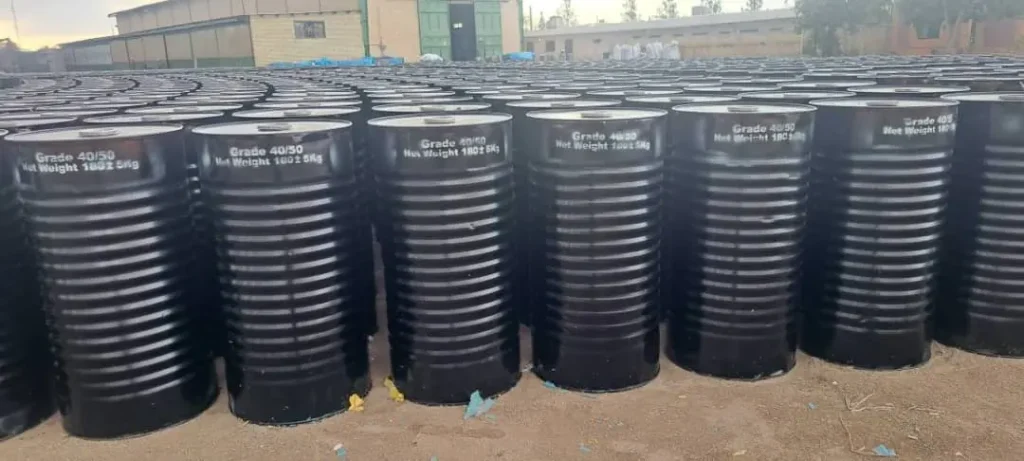
Bitumen Container Loading Capacity determines how much asphalt bitumen exporters can safely transport in a 20ft or 40ft shipping container. A standard 20ft container commonly carries around 18–22 metric tons of packaged bitumen, depending on drum size, jumbo bag dimensions, packaging weight, and legal payload restrictions. However, the actual loading quantity varies considerably between steel drums, jumbo bags, and specialized bulk transportation systems. Understanding these differences helps importers reduce freight costs, plan shipments accurately, and select the most economical packaging method.
For international bitumen buyers, container loading capacity directly affects the landed cost per metric ton. A shipment with inefficient packaging may require additional containers, increase handling expenses, and create unexpected transportation costs. Therefore, buyers should evaluate not only the product price but also the packaging dimensions, net weight, container payload, and unloading conditions at the destination.
1. Bitumen Container Loading Capacity by Packaging Type
Different packaging methods allow exporters to load different quantities of bitumen into shipping containers. Although container dimensions remain relatively consistent, the packaging configuration changes how efficiently suppliers can use the available space.
Steel drums provide strong protection and convenient handling, while jumbo bags can reduce packaging weight and improve loading efficiency. Bulk transportation eliminates individual packages but requires specialized equipment and infrastructure.
Typical Bitumen Container Loading Capacity
| Packaging Type | Typical 20ft Container Load | Main Consideration |
|---|---|---|
| 180 kg steel drums | 90–110 drums | Approximately 16.2–19.8 MT net |
| 200 kg steel drums | 80–100 drums | Approximately 16–20 MT net |
| 300 kg jumbo bags | 60–70 bags | Approximately 18–21 MT net |
| 1,000 kg jumbo bags | 18–24 bags | Approximately 18–24 MT net |
| Specialized bulk systems | System-dependent | Depends on approved tank payload and equipment |
These quantities provide planning examples rather than guaranteed loading specifications. Actual capacity depends on package geometry, container payload, road limits, and the approved loading plan. Some installations cannot safely accommodate the upper quantities shown.
Exporters should verify the final net and gross weights before issuing shipping documents. Container payload limits, rather than available space alone, often determine the maximum permissible load.
2. Bitumen Container Loading Capacity for Steel Drums
Steel drums remain one of the most familiar packaging options in international bitumen trading. Exporters use them because they provide reliable containment, simplify inventory control, and allow buyers to unload shipments without investing in specialized bulk receiving facilities.
A typical bitumen steel drum holds approximately 180 kg or 200 kg of net product, although suppliers may offer different capacities according to customer requirements.
180 kg Bitumen Drum Loading Capacity
A 20ft container may accommodate approximately 90–110 drums containing 180 kg of bitumen each, depending on the drum design and loading arrangement.
For example:
90 drums × 180 kg = 16.2 MT
100 drums × 180 kg = 18 MT
110 drums × 180 kg = 19.8 MT
The supplier must account for the tare weight of every steel drum when calculating total cargo weight.
The drum diameter also influences the number of units that fit across the container floor. Even a small change in diameter can reduce the number of drums in each row.
200 kg Bitumen Drum Loading Capacity
Many international buyers prefer 200 kg drums because they simplify purchasing calculations and reduce the number of packages required for a given shipment quantity.
For example:
80 drums × 200 kg = 16 MT
90 drums × 200 kg = 18 MT
100 drums × 200 kg = 20 MT
However, a 200 kg filling weight does not guarantee that the container can carry 100 drums. Suppliers must consider drum dimensions, tare weight, loading geometry, and cargo securing requirements.
Why Drum Dimensions Matter More Than Buyers Expect
Two suppliers may quote identical net filling weights but offer drums with different diameters or heights.
A wider drum may reduce the number of units per row, while a taller drum may limit stacking options.
Consequently, buyers should request:
Drum height and diameter
Net bitumen weight per drum
Empty drum weight
Number of drums per container
Total net and gross shipment weight
These details help buyers compare suppliers using actual transported quantities rather than assumptions.
3. Bitumen Container Loading Capacity for Jumbo Bags
Jumbo bags offer an alternative to conventional steel drums, particularly for buyers who want to reduce packaging costs and simplify material handling.
Suppliers may use reinforced flexible packaging systems specifically designed for solid or cooled bitumen. The bag structure, lining, lifting arrangement, and thermal performance must match the product and transportation conditions.
300 kg Jumbo Bag Loading Capacity
A 20ft container may carry approximately 60–70 jumbo bags with a nominal filling weight of 300 kg.
The corresponding net cargo weight ranges from:
60 bags = 18 MT
65 bags = 19.5 MT
70 bags = 21 MT
However, the final quantity depends on each bag’s footprint, stacking compatibility, and structural performance.
Exporters should avoid assuming that every jumbo bag can support a second loaded bag. Only approved packaging and loading arrangements should permit stacking.
1,000 kg Jumbo Bag Loading Capacity
Larger packaging units may support higher shipping efficiency for suitable products and approved handling systems.
For example, 20 one-ton bags represent 20 metric tons of net bitumen.
Nevertheless, large-capacity bags require careful assessment. Conventional flexible intermediate bulk containers may not suit hot bitumen, and some products require specialized liners or alternative packaging.
Importers should confirm that the supplier’s proposed packaging system supports the material’s loading temperature, storage conditions, and unloading method.
Jumbo Bags vs Steel Drums
| Factor | Steel Drums | Jumbo Bags |
|---|---|---|
| Packaging material | Steel | Reinforced flexible materials |
| Typical filling weight | 180–200 kg | 300 kg or larger approved units |
| Packaging waste | Higher metal waste | Depends on bag and liner design |
| Handling | Drum handling equipment | Approved lifting equipment |
| Heating and unloading | Usually requires reheating | Depends on specialized bag design |
| Main advantage | Strong packaging protection | Potential savings in packaging and handling |
Jumbo bags do not automatically provide a lower landed cost. Buyers should compare the purchase price, container loading weight, disposal costs, unloading labor, and product losses.
4. How to Calculate Bitumen Container Loading Capacity
Accurate loading calculations require more than multiplying the number of packages by their nominal filling weights.
The simplest calculation determines the net bitumen quantity:
Net Bitumen Weight = Number of Packages × Net Weight per Package
For example, a container with 100 steel drums carrying 180 kg each contains:
100 × 180 kg = 18,000 kg
Therefore, the container transports 18 metric tons of net bitumen.
However, shipping companies and freight forwarders also consider gross cargo weight.
Gross Cargo Weight = Net Bitumen Weight + Total Packaging Weight + Other Cargo Materials
If each empty drum weighs 15 kg, the same shipment adds:
100 × 15 kg = 1,500 kg
The total gross cargo weight becomes 19,500 kg before any additional cargo securing materials.
The container’s permitted payload must exceed the entire cargo weight, including packaging and securing materials.
Container Payload vs Container Volume
One of the most common shipping mistakes involves confusing internal container volume with payload capacity.
Volume measures how much space the container provides. Payload capacity measures how much cargo weight the container can legally and safely carry.
A container may have unused space but already approach its weight limit. Conversely, oversized packaging may occupy the available space before the shipment reaches the maximum permissible payload.
For bitumen exporters, both factors matter.
5. What Affects Bitumen Container Loading Capacity?
Several technical and operational factors determine the actual quantity of bitumen that an exporter can load into a shipping container.
Container Type and Dimensions
Standard 20ft shipping containers generally offer approximately 33 cubic meters of internal volume, although exact dimensions vary among container manufacturers.
A standard 40ft container provides substantially more volume but does not offer twice the payload capacity of a 20ft container.
Because bitumen is relatively dense, weight restrictions frequently make 20ft containers more practical for heavy packaged shipments.
Bitumen Grade and Temperature
Bitumen grades such as Bitumen 60/70, Bitumen 80/100, 40/50, and 85/100 may require different handling conditions.
Temperature affects the product’s flow behavior, while packaging suitability depends on the material’s physical characteristics and filling conditions.
For instance, suppliers who package penetration-grade bitumen in steel drums must control filling temperatures and allow suitable cooling and stabilization before container loading.
Packaging Tare Weight
Packaging tare weight increases the gross weight without increasing the quantity of bitumen delivered.
A shipment with heavier drums may transport less net product under the same cargo weight restriction.
Therefore, buyers should compare net shipment weight rather than simply counting packages.
Weight Distribution and Cargo Securing
Exporters must distribute cargo weight appropriately across the container floor.
Poor weight distribution can overload local floor areas, complicate handling, or create transportation hazards.
Additionally, drums and bags need suitable blocking, bracing, and restraint to prevent movement during vessel transportation.
Destination Regulations
Legal weight limits differ between countries and transportation routes.
A container may satisfy maritime shipping requirements but exceed the permitted weight for road transportation at the destination.
Consequently, importers should confirm local road and axle limits before selecting the final loading quantity.
6. 20ft vs 40ft Container for Bitumen Transportation
Importers sometimes assume that a 40ft container provides the lowest freight cost because it offers more internal space.
However, this assumption does not always hold for heavy commodities.
A 20ft container often provides a favorable relationship between cargo weight and internal volume.
A 40ft container offers more room for loading, but its permitted payload may not increase enough to justify the additional space.
| Feature | 20ft Container | 40ft Container |
|---|---|---|
| Internal volume | Approximately 33 m³ | Approximately 67 m³ |
| Maximum gross mass | Often 30,480 kg | Often 30,480 kg |
| Payload | Equipment-specific | Equipment-specific |
| Suitability for dense bitumen | Often preferred | Depends on shipment design |
| Main advantage | Efficient heavy-cargo shipping | Greater available volume |
Container specifications vary. Check the Container Safety Approval Plate, equipment data, and transport restrictions for the actual container.
For most conventional dense bitumen shipments, exporters should evaluate a 20ft container first and compare freight quotations against alternative equipment.
7. Bulk Bitumen Transportation and Specialized Containers
Bulk bitumen transportation eliminates individual drums and bags, allowing suppliers to move large quantities through dedicated systems.
However, bulk shipping requires more infrastructure than conventional packaged transportation.
Bulk transportation options can include:
Heated road tankers
Dedicated bitumen tank containers
Specialized insulated equipment
Bulk bitumen vessels
Approved systems for compatible temperature-controlled products
Importers should distinguish between ordinary liquid flexitanks and equipment specifically engineered for bitumen.
Standard flexitanks do not automatically support hot asphalt bitumen. High temperatures, product viscosity, container compatibility, and discharge requirements may make them unsuitable.
Specialized bitumen tanks or purpose-designed systems provide more appropriate solutions when the supplier and buyer have the necessary handling equipment.
When Does Bulk Shipping Make Financial Sense?
Bulk transportation generally becomes more attractive when buyers order large volumes regularly and can receive, store, and discharge bitumen safely.
However, small importers may find steel drums more practical because they avoid specialized receiving infrastructure.
The correct decision depends on total logistics costs rather than packaging cost alone.
8. How Container Loading Capacity Affects Bitumen Shipping Costs
Freight companies often quote ocean transportation costs per container rather than per metric ton of product.
As a result, increasing the net cargo weight can reduce the transportation cost allocated to each ton.
Consider two hypothetical shipments with the same $1,500 ocean freight charge:
| Shipment | Net Bitumen | Ocean Freight per MT |
|---|---|---|
| Container A | 18 MT | $83.33 |
| Container B | 20 MT | $75.00 |
The second shipment saves approximately $8.33 per metric ton in ocean freight allocation.
For a buyer importing 1,000 metric tons, that difference represents approximately $8,330.
However, importers must not exceed approved weight restrictions to achieve these savings.
Furthermore, freight costs alone do not reflect the full landed cost. Packaging, terminal handling, customs processing, inland transportation, demurrage, and unloading expenses can change the final comparison.
Why Maximum Loading Does Not Always Mean Minimum Cost
A container that carries more bitumen may incur additional inland transportation costs if its gross weight requires a special truck arrangement.
Similarly, a packaging system that improves loading efficiency may increase unloading labor or equipment expenses.
Therefore, procurement teams should evaluate the complete shipment cost per delivered metric ton.
9. Choosing the Best Packaging for International Bitumen Shipments
The best packaging option depends on the importer’s purchasing volume, destination facilities, and operating requirements.
Steel Drums for Flexible Distribution
Steel drums work well for customers who distribute bitumen to multiple construction sites or need smaller quantities for individual projects.
Drums also allow buyers to store units separately and manage inventory with relatively simple equipment.
Jumbo Bags for Suitable High-Volume Operations
Specialized jumbo bags may benefit buyers who prioritize packaging efficiency and have compatible material handling systems.
However, packaging integrity, product temperature, and unloading procedures require careful verification.
Bulk Transportation for Industrial Buyers
Bulk shipments generally suit asphalt plants, major road contractors, and industrial consumers with suitable storage tanks and dedicated unloading equipment.
Large-volume purchasers should compare the capital and operational requirements against potential freight and packaging savings.
10. Important Questions to Ask Before Ordering Bitumen
Before placing a purchase order, importers should request a written loading specification from the supplier.
The specification should identify:
The exact bitumen grade and test standard.
The packaging type and nominal filling weight.
The total number of drums or bags per container.
The net product weight and gross cargo weight.
The packaging dimensions and empty packaging weight.
The container type and applicable payload restrictions.
The loading, securing, and unloading methods.
The relevant technical documents, including TDS, SDS, and inspection certificates when applicable.
These details help prevent disagreements over delivered quantities and transportation arrangements.
Importers should also confirm whether the quotation specifies net metric tons or gross weight. This distinction matters when comparing different packaging offers.
11. Frequently Asked Questions About Bitumen Container Loading Capacity
1. How many tons of bitumen fit in a 20ft container?
A 20ft container commonly carries around 18–22 metric tons of packaged bitumen under suitable conditions. The actual quantity depends on packaging, cargo weight, container specifications, and transport restrictions.
2. How many bitumen drums fit in a 20ft container?
A 20ft container may carry approximately 90–110 drums of 180 kg bitumen or 80–100 drums of 200 kg bitumen, depending on drum dimensions and the approved loading arrangement.
3. What is the loading capacity for bitumen jumbo bags?
For 300 kg jumbo bags, a planning range of 60–70 bags represents approximately 18–21 metric tons. Actual quantities depend on bag dimensions, structural suitability, and loading restrictions.
4. Is a 20ft or 40ft container better for bitumen?
A 20ft container often provides a more practical solution for dense packaged bitumen because it offers sufficient payload capacity without excessive unused volume. However, freight pricing and shipment requirements determine the final choice.
5. Can exporters ship bitumen in bulk containers?
Yes. Exporters can use dedicated bitumen tank containers or other approved specialized bulk systems. The equipment must support the product’s temperature, physical properties, and unloading requirements.
6. Does bitumen grade affect container loading capacity?
Bitumen grade can influence handling temperature and packaging selection. However, packaging weight, dimensions, and transportation limits usually have a greater effect on the final loading quantity.
7. How can importers reduce bitumen shipping costs?
Importers can compare packaging options, request verified loading plans, increase net cargo efficiency within legal limits, and calculate the complete landed cost per metric ton.
8. What information should a supplier include in a loading report?
A loading report should confirm the container number, packaging quantity, net and gross weights, cargo arrangement, and relevant inspection or shipment details.
Conclusion
Accurate Bitumen Container Loading Capacity calculations help buyers control transportation expenses, avoid overloading, and select suitable packaging for international shipments. Steel drums remain a practical choice for flexible distribution, while specialized jumbo bags and bulk systems may offer advantages under suitable operating conditions.
The most economical shipment is not necessarily the one with the highest number of packages. Importers should compare net delivered weight, packaging requirements, transportation restrictions, and total landed costs.
Before confirming a shipment, request a detailed container loading plan from the supplier and verify the actual quantities with the freight forwarder. This approach supports safer transportation, more reliable delivery planning, and better purchasing decisions.